In fragile and conflict-affected environments, non-governmental organizations often operate under conditions that combine humanitarian urgency, political sensitivity, and intense scrutiny. Access is negotiated carefully, trust is fragile, and legitimacy can determine whether an organization is allowed to operate at all. In these settings, media credibility is not a communications preference. It is an operational necessity.
Across Africa, non-governmental organizations (NGOs) play a critical role in delivering essential services, supporting vulnerable communities, and implementing development programs in areas where state capacity is limited or absent. From rural healthcare and education to humanitarian response, climate adaptation, and livelihood support, NGOs often operate at the frontline—reaching populations that governments, markets, and formal institutions struggle to serve consistently. Their ability to operate effectively depends not only on technical capacity, but also on trust, credibility, funding continuity, and public accountability.
Nowhere is this more visible than in fragile states.
Operating Where the State Cannot
In conflict-affected countries, NGOs frequently provide life-saving services that no other actors are positioned to deliver. These may include food assistance, emergency healthcare, protection for displaced populations, water and sanitation, and support for basic livelihoods. Governments in such contexts may lack territorial control, administrative reach, or the resources required to deliver services consistently.
In South Sudan, for example, years of conflict, displacement, and economic fragility have created conditions where humanitarian and development NGOs are central to civilian survival in many regions. Access to communities is negotiated carefully. Neutrality is scrutinized constantly. Funding is competitive and closely monitored. In such an environment, perception matters as much as performance.
Why Credibility Determines Access
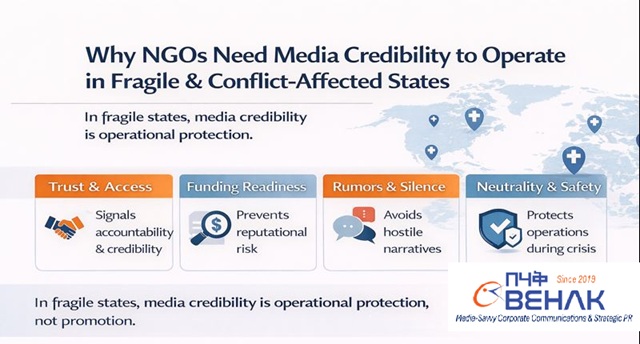
For NGOs working in fragile states, access is rarely guaranteed. It must be earned and continuously maintained. Governments, local authorities, community leaders, donors, and international partners all assess whether an organization can be trusted to operate responsibly. Media credibility plays a critical role in this assessment.
Credible, independent media coverage signals that an organization’s work has been observed, contextualized, and deemed relevant by third parties. It demonstrates that the NGO is not operating invisibly or unaccountably. This matters deeply in environments where suspicion is high and misinformation spreads easily.
An NGO with a clear, consistent public record is easier to defend—to donors, to regulators, and to local stakeholders. One without such a record may face additional scrutiny, delays, or even restrictions, regardless of the quality of its work.
The Limits of Silence in Fragile Contexts
Some NGOs operating in sensitive environments choose to remain silent publicly, fearing that visibility could attract political attention or compromise neutrality. While discretion is often necessary, complete silence can be counterproductive.
In fragile contexts, silence creates an information vacuum. That vacuum is often filled by rumor, speculation, or hostile narratives. Without credible public references, external actors are left to infer motives, affiliations, or competence without evidence.
Strategic visibility does not mean advocacy or self-promotion. It means ensuring that accurate, neutral information about an organization’s mission, approach, and track record is available through trusted channels.
Media as a Shield, Not a Spotlight
For NGOs in conflict-affected states, media engagement should not be understood as exposure. It should be understood as protection.
When an organization has been featured responsibly in credible media—through contextual reporting, humanitarian features, or expert commentary—it builds a reputational buffer. This buffer can be critical during periods of crisis, accusation, or operational challenge.
In South Sudan and similar environments, NGOs with documented public records are often better positioned to respond to scrutiny because their narratives already exist outside their own reports and press statements.
Funding Decisions Begin Before Proposals Are Reviewed
Donors supporting fragile-state operations face heightened accountability requirements. Funding decisions are rarely based on proposals alone. Background checks, reputational screening, and media reviews increasingly precede formal evaluations.
Donor institutions need to assure boards, taxpayers, and oversight bodies that their funds are not exposed to reputational risk. NGOs with a visible, consistent media footprint are easier to approve. Their work is easier to justify internally. Their leadership appears accountable.
This does not require constant coverage. It requires credible, accurate, and sustained presence over time.
Communicating Complexity Without Compromising Neutrality
Humanitarian and development work in fragile states is complex. Programs face setbacks. Access is disrupted. Security conditions change. Communicating this reality responsibly is a mark of institutional maturity.
Media engagement allows NGOs to contextualize challenges, explain constraints, and demonstrate adaptive capacity. This transparency strengthens trust rather than weakening it. Donors and partners understand that fragile environments are unpredictable. What they seek is honesty and professionalism.
Strategic communication helps NGOs balance visibility with neutrality—ensuring that information is shared without politicization or sensationalism.
The Role of Trusted Digital Voices
In addition to traditional media, NGOs increasingly operate within a digital information environment shaped by policy analysts, humanitarian experts, journalists, and development practitioners. These voices often engage on professional platforms, shaping discourse within donor and policy communities.
When such voices reference an NGO’s work—through analysis, commentary, or informed discussion—it reinforces legitimacy. This is not influencer marketing. It is professional validation.
Used carefully, these engagements complement earned media by extending reach within relevant communities without undermining neutrality.
Reputational Risk Is Operational Risk
In fragile states, reputational risk and operational risk are closely linked. Loss of trust can lead to restricted access, funding suspensions, or program disruption. Conversely, strong reputational standing can facilitate coordination, protect staff, and stabilize operations during volatile periods.
This is why public relations for NGOs in fragile contexts should be understood as risk management and institutional safeguarding, not promotion.
Conclusion: Credibility Enables Presence
In conflict-affected and fragile states, NGOs are often the last line of support for vulnerable populations. Their ability to operate depends on more than logistics and funding. It depends on trust.
Media credibility helps build that trust. It supports access, reassures donors, and protects institutional legitimacy in environments where misunderstanding can have serious consequences.
For NGOs operating in fragile states like South Sudan, strategic communication is not about visibility for its own sake. It is about ensuring that critical work can continue—safely, credibly, and sustainably.