
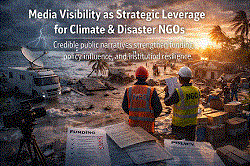
Climate change and disaster risk are reshaping the development landscape across Africa. Floods, cyclones, droughts, and extreme weather events now occur with greater frequency and severity, placing sustained pressure on communities, governments, and humanitarian systems.
In this environment, non-governmental organizations working on climate adaptation and disaster response have become essential actors – not only in emergency relief, but in preparedness, resilience, and recovery.
Yet as climate risks intensify, so does scrutiny. Funding is competitive. Policy attention is crowded. Public expectations are high. For climate and disaster NGOs, technical competence alone is no longer sufficient. Media visibility – grounded in credibility and accuracy – has become central to influencing funding decisions and shaping policy engagement.
Across Africa, non-governmental organizations (NGOs) play a critical role in delivering essential services, supporting vulnerable communities, and implementing development programs in areas where state capacity is limited or absent.
From rural healthcare and education to humanitarian response, climate adaptation, and livelihood support, NGOs often operate at the frontline – reaching populations that governments, markets, and formal institutions struggle to serve consistently. Their ability to operate effectively depends not only on technical capacity, but also on trust, credibility, funding continuity, and public accountability.
Climate and Disaster Work Is Increasingly Under the Spotlight
Climate and disaster programs operate at the intersection of science, policy, humanitarian response, and community engagement. Decisions about where to allocate resources are influenced by public narratives as much as by technical assessments.
Donors and policymakers are under pressure to justify climate spending to boards, parliaments, and taxpayers. They need credible partners whose work can be explained publicly and defended institutionally. As a result, climate and disaster NGOs are increasingly evaluated not only on outcomes, but on how clearly their work is understood beyond project documentation. Media Visibility plays a decisive role in that understanding.
A Climate and Disaster Context in Mozambique
In Mozambique, climate-related disasters have become a defining development challenge. Recurrent cyclones, flooding, and storm surges have devastated coastal communities, disrupted livelihoods, and damaged infrastructure. NGOs play a central role in emergency response, early warning systems, shelter reconstruction, and community-based resilience programs.
These organizations often operate in coordination with government agencies, international donors, and local communities under intense time pressure. When disasters strike, decisions about funding allocations, scale-up, and coordination must be made quickly.
In such contexts, NGOs with established public credibility are more likely to be trusted as implementing partners. Their past work is easier to reference. Their expertise is easier to recognize. Their capacity to operate responsibly is less questioned.
Why Visibility Influences Funding Decisions
Climate and disaster funding is highly competitive. Donors prioritize organizations that can demonstrate impact, accountability, and learning across multiple cycles of response and recovery.
While technical reports provide evidence, they rarely shape broader perceptions. Media coverage and public discourse help translate complex interventions – such as early warning systems or climate-resilient housing – into narratives that non-technical decision-makers can grasp.
When credible media document how NGOs are reducing disaster risk, adapting livelihoods, or rebuilding communities, they provide third-party validation. This validation reduces uncertainty for donors deciding where to allocate limited resources.
A visible track record often shortens approval timelines and strengthens funding continuity.
Policy Influence Requires Public Legitimacy
Climate adaptation and disaster risk reduction increasingly involve policy engagement. NGOs contribute evidence, pilot innovations, and advocate for community-centered approaches. To influence policy, however, NGOs must be perceived as legitimate knowledge actors.
Public visibility supports this legitimacy. When NGOs are referenced in credible media, cited by analysts, or engaged by policy commentators, their expertise is recognized beyond closed technical forums.
This recognition matters because policy processes are shaped by public narratives. Organizations that are invisible in public discourse often struggle to influence decisions, regardless of the quality of their evidence.
Beyond Emergency Response: Communicating Preparedness and Prevention
One of the challenges for climate and disaster NGOs is that success often means disasters are less severe or less visible. Preparedness and prevention rarely generate dramatic images, yet they deliver the greatest long-term value.
Strategic communication helps NGOs explain why investments in early warning, resilient infrastructure, and community training matter—especially when no immediate crisis is unfolding. Media engagement allows NGOs to articulate the value of prevention before disasters strike.
Without this visibility, funding may skew toward reactive response rather than long-term resilience.
Managing Complexity and Uncertainty Publicly
Climate and disaster work involves uncertainty. Forecasts change. Climate models evolve. Interventions must adapt to new information. Communicating this complexity transparently is a sign of institutional maturity.
Credible media provide a platform for NGOs to explain uncertainties responsibly, share lessons learned, and demonstrate adaptive management. This transparency strengthens trust with donors and policymakers who understand that climate work is inherently complex.
Silence or overly simplified narratives, by contrast, can undermine confidence when realities diverge from expectations.
The Role of Trusted Digital and Expert Voices
Climate discourse is shaped by scientists, environmental analysts, humanitarian experts, and regional commentators who engage publicly through professional platforms. These voices influence how climate risks and responses are understood by decision-makers.
When such experts reference NGO work, engage with evidence, or contextualize interventions, they reinforce credibility. This is not promotional activity. It is knowledge exchange within a professional ecosystem.
When aligned with earned media, these engagements extend reach without compromising neutrality.
Reputational Risk in High-Visibility Crises
Disasters attract attention. Media scrutiny intensifies during crises. Inaccurate information, delayed responses, or unclear communication can quickly damage reputations.
NGOs with established public records are better positioned to manage such moments. Their past transparency provides context. Their credibility has already been tested. This reputational capital acts as a buffer during high-pressure situations.
For climate and disaster NGOs, reputational risk is inseparable from operational risk.
Conclusion: Visibility Enables Climate Action at Scale
Climate and disaster NGOs operate in environments where urgency, uncertainty, and scrutiny converge. Their ability to secure funding, influence policy, and sustain long-term resilience work depends on more than technical capacity.
Credible visibility—built through responsible media engagement and thoughtful public communication—helps translate complex climate work into trusted narratives. It reassures donors, informs policymakers, and supports communities before, during, and after crises.
In climate-vulnerable countries like Mozambique, media visibility is not about attention. It is about enabling effective action at scale.