
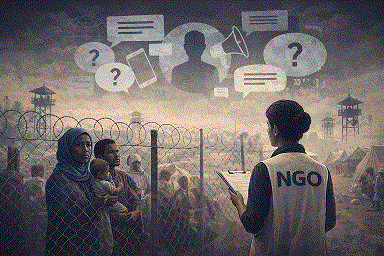
Refugee and displacement responses are among the most scrutinized areas of humanitarian work. Programs operate under intense public attention, complex political dynamics, and heightened donor accountability. In such environments, ambiguity about an organization’s credibility can quickly translate into operational risk.
For NGOs supporting displaced populations, reputation is not a secondary concern. It directly affects access, funding continuity, coordination with authorities, and the safety of staff and beneficiaries.
Across Africa, non-governmental organizations (NGOs) play a critical role in delivering essential services, supporting vulnerable communities, and implementing development programs in areas where state capacity is limited or absent.
From rural healthcare and education to humanitarian response, climate adaptation, and livelihood support, NGOs often operate at the frontline—reaching populations that governments, markets, and formal institutions struggle to serve consistently. Their ability to operate effectively depends not only on technical capacity, but also on trust, credibility, funding continuity, and public accountability.
Displacement Contexts Demand Higher Credibility
Displacement settings bring together multiple stakeholders with overlapping interests: host governments, local communities, international agencies, donors, security actors, and the displaced populations themselves. Each stakeholder evaluates NGOs through a different lens, but all share one concern—risk.
In these contexts, credibility determines whether an NGO is perceived as neutral, competent, and accountable. A lack of clear public information can raise questions about governance, affiliations, or capacity, even when programs are well managed.
A Refugee Response Context in Kenya
In Kenya, NGOs have long supported refugee populations originating from neighboring conflict-affected countries. These organizations provide essential services including shelter, healthcare, education, psychosocial support, and livelihood assistance in refugee-hosting regions.
Operations often take place under close government oversight and public debate around migration, security, and resource allocation. NGOs must demonstrate not only humanitarian effectiveness but also transparency and respect for national frameworks.
In this environment, reputational clarity is essential. NGOs with visible, consistent public records are better positioned to navigate regulatory scrutiny, coordinate with authorities, and reassure donors. Those with unclear or inconsistent narratives may face delays, restrictions, or reduced funding.
Why Silence Creates Risk in Refugee Work
Some NGOs choose minimal public engagement to avoid controversy. While discretion is often necessary, complete silence can create unintended consequences.
In refugee contexts, silence leaves room for speculation. Misinformation can spread quickly, especially in politically sensitive environments. Without credible public references, NGOs may find themselves responding defensively to narratives they did not shape.
Strategic visibility does not mean advocacy or self-promotion. It means ensuring that accurate, neutral information about an organization’s mandate, activities, and safeguards is available through trusted channels.
Media Credibility as a Stabilizing Force
Independent media coverage plays a stabilizing role in displacement contexts. Responsible reporting helps contextualize humanitarian work, explain constraints, and counter misinformation.
For NGOs, being referenced in credible media signals that their work has been observed and evaluated externally. This third-party validation is particularly valuable when donors conduct reputational screening before approving or renewing funding.
A single well-contextualized media feature can often reassure stakeholders more effectively than multiple internal updates, because it reflects editorial judgment rather than organizational messaging.
Funding Decisions and Reputational Screening
Refugee programs are resource-intensive and often funded through multi-year commitments. Donors supporting such programs face heightened reputational exposure and therefore conduct rigorous background checks.
These checks increasingly include media reviews. Donors assess whether an NGO has been involved in controversies, how it has communicated publicly, and whether its narrative aligns with humanitarian principles.
Organizations with a consistent, neutral public presence are easier to approve and defend internally. Those without visible records may face additional scrutiny, regardless of program performance.
Communicating Challenges Without Undermining Neutrality
Refugee responses are complex. Overcrowding, funding gaps, security incidents, and policy shifts can affect operations. Communicating these challenges responsibly is a sign of institutional maturity.
Media engagement allows NGOs to explain difficulties without politicization. It helps donors and partners understand constraints while reinforcing professionalism and accountability.
Avoiding communication altogether can create the impression that challenges are being concealed rather than managed.
The Role of Trusted Digital Voices
In displacement contexts, digital discourse is often shaped by humanitarian analysts, migration experts, journalists, and policy commentators. These voices influence how refugee issues are perceived by the public and decision-makers.
When such voices engage constructively with NGO work—through analysis, commentary, or evidence-based discussion—they reinforce legitimacy. This is not promotional activity. It is professional validation within a complex policy space.
When aligned carefully with earned media, this engagement strengthens reputational resilience.
Reputational Risk Is Operational Risk
For NGOs working with refugees, reputational risk can quickly become operational risk. Loss of trust can lead to restricted access, strained relations with authorities, or funding disruptions.
Conversely, strong reputational standing can facilitate coordination, protect staff, and stabilize operations during periods of heightened scrutiny.
This is why public relations in refugee contexts should be understood as risk management and institutional safeguarding.
Conclusion: Clarity Enables Continuity
NGOs working with displaced populations operate in environments where trust is fragile and scrutiny is constant. In these settings, reputational ambiguity is a liability.
Credible media presence and strategic communication help NGOs clarify their role, reinforce neutrality, and sustain the confidence required to continue life-saving work.
In refugee-hosting countries like Kenya, visibility is not about attention. It is about continuity, access, and trust.