
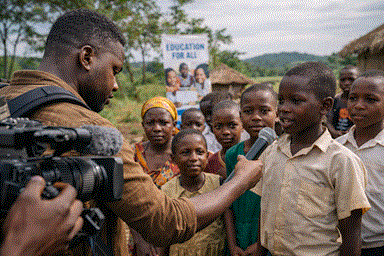
Education is one of the most transformative development interventions, yet it is also one of the most resource-intensive and long-term. Unlike emergency response or short-cycle humanitarian aid, education programs require sustained funding, institutional continuity, and long-term trust between donors, governments, and implementing organizations.
For education-focused NGOs, success is measured over years rather than months. This makes credibility, visibility, and public trust central to program survival. Without them, even high-impact initiatives struggle to secure long-term donor commitment.
Across Africa, non-governmental organizations (NGOs) play a critical role in delivering essential services, supporting vulnerable communities, and implementing development programs in areas where state capacity is limited or absent. From rural healthcare and education to humanitarian response, climate adaptation, and livelihood support, NGOs often operate at the frontline—reaching populations that governments, markets, and formal institutions struggle to serve consistently. Their ability to operate effectively depends not only on technical capacity, but also on trust, credibility, funding continuity, and public accountability.
Education NGOs and the Sustainability Challenge
Education NGOs often operate where public education systems face chronic constraints: overcrowded classrooms, teacher shortages, limited infrastructure, and unequal access for marginalized communities. These organizations fill gaps by supporting schools, training teachers, developing curricula, providing learning materials, and expanding access for girls and vulnerable youth.
However, education outcomes take time to materialize. Literacy rates, skills acquisition, and employment outcomes cannot be demonstrated instantly. Donors therefore rely heavily on institutional credibility when deciding whether to sustain funding over multiple years.
Visibility plays a critical role in shaping that credibility.
A Uganda Education Context
In Uganda, education NGOs play a significant role in improving access to schooling and vocational skills, particularly in rural districts and refugee-hosting areas. NGOs support early childhood education, secondary school retention, teacher training, and youth skills development programs aligned with labor market needs.
Many of these initiatives operate alongside government systems, complementing national education strategies. Yet competition for education funding is intense, and donors increasingly expect clear evidence of impact, accountability, and institutional maturity.
In this context, NGOs that are visible and well-understood publicly are better positioned to secure long-term donor commitment. Those that rely solely on internal reports and proposals may struggle to differentiate themselves, even when delivering strong results.
Why Donors Look Beyond Project Reports
Education donors rarely assess programs in isolation. They evaluate organizations. While project reports provide technical detail, they are often read only by program officers. Decision-makers—boards, funding committees, and external reviewers—also look for broader signals of credibility.
Media coverage helps provide those signals. When an education NGO’s work is referenced in credible media—through features on learning outcomes, interviews with educators, or reporting on community impact—it demonstrates that the organization’s work resonates beyond donor documentation.
This third-party validation matters because education funding is reputationally sensitive. Donors want assurance that supported programs are legitimate, visible, and accountable to the public.
Visibility as Institutional Memory
Education programs often span leadership changes, donor transitions, and policy shifts. Media presence helps create institutional memory beyond internal archives.
A documented public record allows new donors, government partners, and stakeholders to understand an organization’s trajectory, philosophy, and experience. It provides continuity when personnel change and helps preserve credibility over time. For education NGOs, this continuity is essential to sustaining multi-year commitments.
Communicating Educational Challenges Responsibly
Education interventions face inevitable challenges: dropout rates, cultural barriers, resource limitations, and external shocks such as conflict or pandemics. Communicating these challenges transparently is part of institutional maturity.
Media engagement allows NGOs to contextualize setbacks, explain adaptive strategies, and highlight learning. Donors are more likely to sustain funding when they see honesty and professionalism rather than polished but incomplete narratives.
Silence, by contrast, can raise concerns. When no public information exists, stakeholders may question whether challenges are being acknowledged or addressed.
The Role of Digital Thought Leadership in Education
Education NGOs increasingly contribute to policy discussions, research dissemination, and sector learning. Education specialists, researchers, and development practitioners often engage in public discourse through professional platforms.
When education NGOs participate thoughtfully in these conversations—sharing insights, lessons learned, or evidence-based perspectives—they reinforce their credibility as knowledge contributors, not just implementers. This form of visibility supports donor confidence without compromising neutrality or focus.
Reputation and Long-Term Funding Decisions
Long-term education funding depends on trust. Donors commit resources not only to programs, but to institutions they believe can steward funds responsibly over time.
A strong public reputation reduces perceived risk. It reassures donors that an organization can withstand scrutiny, adapt to challenges, and remain accountable to both beneficiaries and funders. Education NGOs that invest in strategic communication are therefore investing in sustainability.
In conclusion, visibility supports educational continuity
Education NGOs operate on long timelines. Their success depends on sustained trust and consistent support. Strategic communication and credible media presence help education NGOs demonstrate accountability, reinforce legitimacy, and secure the long-term donor commitment required to achieve meaningful educational outcomes. In countries like Uganda, where education needs remain high and resources are constrained, visibility is not about recognition. It is about continuity.