Cross-border business decisions rarely begin with formal due diligence. They begin with a search. Before proposals are exchanged or documents requested, executives and compliance teams perform an informal credibility check. They look for independent signals that a company exists beyond its own marketing. They search for the business name, scan media references, and assess whether the company has appeared in credible news coverage.
In an African Continental Free Trade Area (AfCFTA) environment, this quiet screening step increasingly determines who gets a call back.
The African Continental Free Trade Area (AfCFTA) has fundamentally changed how African businesses are evaluated. By connecting 54 countries into a single market, it has expanded opportunity—but also comparison. Companies are no longer assessed only against local competitors. They are measured against unfamiliar firms across borders, cultures, and regulatory systems.
When familiarity disappears, verifiability becomes decisive.
Informal Due Diligence Comes First
Before engaging lawyers, consultants, or due-diligence providers, decision-makers want fast answers to basic questions:
• Is this company real and active?
• Has it been referenced independently?
• Does it have a public footprint beyond its own website?
• Is there any visible controversy or instability?
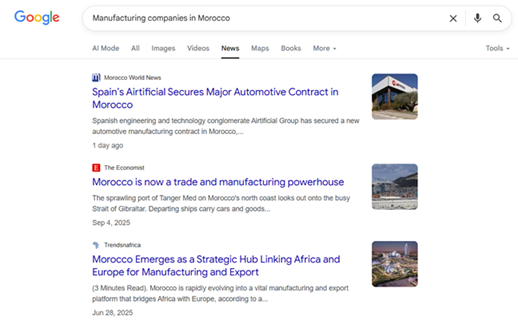
Google News has become one of the fastest tools for answering these questions. Unlike general web results, Google News prioritizes editorial content—articles, interviews, and reports published by recognized media outlets.
Appearing there signals that a business has passed at least one external credibility filter.
AfCFTA Has Raised the Bar for Trust
Consider a typical AfCFTA scenario:
A logistics company in East Africa explores a joint venture with a West African manufacturer to serve multiple regional corridors. The firms have no shared history and no overlapping networks. Before discussions progress, internal teams conduct a background review. What appears in business media? Has either company been referenced in trade, sector, or economic coverage?
If one firm shows up in credible news articles and the other exists only through self-published channels, the perceived risk immediately diverges—even if both firms are operationally sound. This is not bias. It is risk management under uncertainty.
Why Owned Channels Are Not Enough
Websites, brochures, and social media profiles are essential—but they are self-reported. From a risk and compliance perspective, they carry limited weight. Many SMEs assume credibility is cumulative: more directories, more posts, more branding. In practice, reputational assessment works differently.
One independent media feature often outweighs dozens of directories or a polished website. The reason is simple: editorial coverage represents third-party validation. It shows that someone outside the company found it relevant, credible, and worth referencing. For partners unfamiliar with a firm’s local context, this matters far more than design or digital activity.
The Strategic Advantage of Being Searchable
Companies that appear in Google News results are easier to:
• explain internally,
• justify to compliance teams,
• defend during partner approvals,
• and assess under time pressure.
Companies without any independent media footprint are harder to evaluate—even if they are competent and legitimate. In competitive AfCFTA environments, that friction alone can be disqualifying.
Invisible companies are not necessarily weak. They are simply unverifiable.
Why Many SMEs Misjudge the Timing
A common assumption is that media visibility should come after expansion. In reality, expansion often depends on visibility already being in place. Opportunities under AfCFTA arise quickly—tenders, partnerships, introductions. When they do, partners do not wait months for credibility to be established. They move forward with companies they can assess immediately. Those with an existing media footprint advance smoothly. Others struggle to catch up.
Visibility Is a Long-Term Asset
Media presence is not built overnight. It develops through consistent engagement: interviews, business features, sector commentary, and trade-related reporting. Over time, these references form a public record that supports informal and formal due diligence alike. For African SMEs operating across borders, media visibility is no longer promotional. It is preparatory.
AfCFTA Rewards the Verifiable
– AfCFTA expands markets, but it also expands choice. As partners compare businesses across multiple countries, they favor those that are visible, verifiable, and accountable.
– Being found in Google News does not guarantee success.
– Not being found increasingly guarantees exclusion.
Get BEHAK PR Solutions’ media visibility and engagement services.