
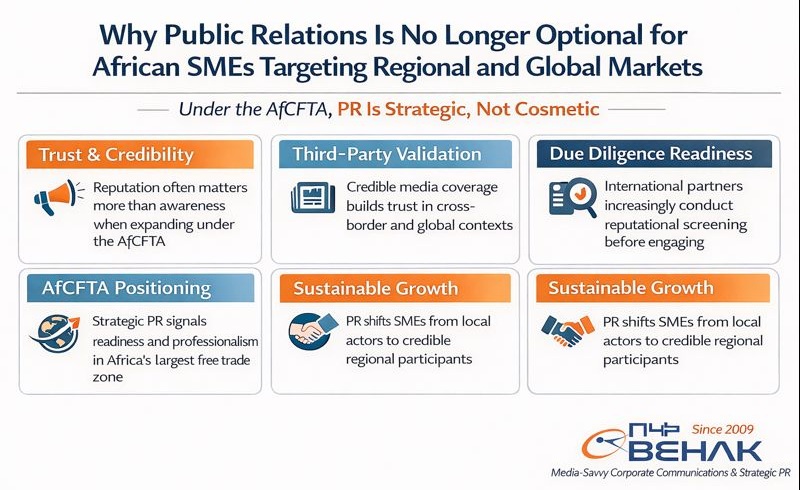
Public Relations (PR) is often misunderstood by small and medium enterprises (SMEs). It is commonly viewed as a cosmetic activity, something to consider only after a company has grown significantly. Under AfCFTA and global competition, this perception no longer reflects reality.
The African Continental Free Trade Area (AfCFTA) was established through an agreement signed in 2018 and officially commenced trading in January 2021. It brings together 54 African countries, making it the largest free trade area in the world by number of participating states. AfCFTA aims to create a single continental market for goods and services, facilitate the free movement of business persons and investments, and strengthen Africa’s position in global trade by promoting intra-African commerce, industrialization, and regional value chains.
As African SMEs expand across borders, they enter environments where personal familiarity is limited and scrutiny is higher. In these settings, public relations has become a strategic business function rather than a discretionary expense.
PR Is About Trust, Not Publicity
Advertising promotes products. Public relations builds trust.
For SMEs seeking regional or global opportunities, trust is often more decisive than awareness. Buyers, partners, and investors want confidence that a company is legitimate, stable, and capable of operating beyond its domestic market.
PR shapes this confidence by influencing how a business is perceived externally, through credible narratives and independent media engagement.
A Cross-Border Investment Perspective
Consider a venture capital firm based in South Africa evaluating potential investments in manufacturing SMEs in Ethiopia. Before requesting financial statements or conducting site visits, the firm performs an initial reputational scan. Analysts search for independent media mentions, business interviews, and public commentary involving the companies and their founders.
An Ethiopian manufacturer that has appeared in credible business media is perceived as easier to evaluate. Its visibility suggests accountability and readiness for external scrutiny. Another manufacturer with similar financials but no public footprint appears riskier, even if its operations are sound. In many cases, the first company advances to deeper due diligence while the second does not.
PR as Market Access Infrastructure
Under AfCFTA, PR functions as market access infrastructure. It allows SMEs to signal readiness for regional engagement by demonstrating visibility, coherence, and credibility.
This is particularly valuable for businesses that cannot afford physical presence across multiple markets. PR enables relevance without permanent offices.
Many SMEs assume that visibility is cumulative—that appearing on multiple business directories, maintaining a company website, or having an active social media presence creates credibility. In practice, these forms of visibility carry limited weight in reputational assessment.
A single press release, interview, or feature published by a credible, independent media outlet often has far greater impact than ten directory listings or a well-designed website. This is because media coverage represents third-party validation. It signals that the business has been assessed, referenced, and deemed relevant by an external actor rather than simply promoting itself.
Why Reactive Communication Fails
Many SMEs engage in communication only when prompted by opportunity or crisis. This reactive approach is ineffective in competitive environments.
Reputation must be established before scrutiny intensifies. Companies that wait until they need visibility often discover that trust cannot be built quickly enough.
Strategic PR is preventative, not reactive.
Supporting Global Due Diligence Expectations
As African SMEs seek international partners, they encounter global due diligence standards that increasingly include reputational screening. Companies with no media footprint appear unprepared. Those with consistent, credible public presence appear safer and more professional.
PR ensures that when due diligence begins, the public record supports — rather than undermines — the company’s ambitions.
From Local Operator to Regional Participant
Transitioning from a local business to a regional participant requires recognition. PR helps SMEs enter broader business conversations and industry narratives that extend beyond national borders.
This recognition does not happen by chance. It must be built deliberately and sustained.
AfCFTA Rewards Preparedness
AfCFTA is a long-term structural shift. Businesses that prepare early by investing in visibility, credibility, and reputation gain a lasting advantage.
For African SMEs targeting regional and global markets, PR is no longer optional. It is part of the cost of serious growth.