
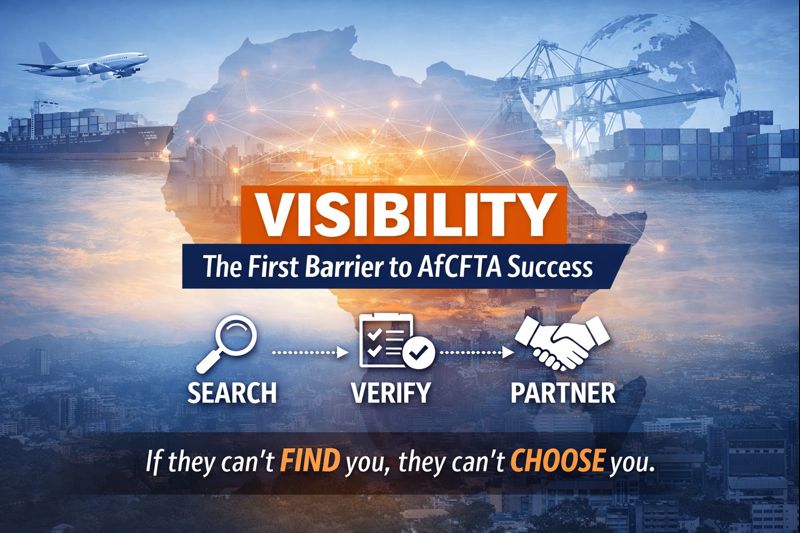
Across Africa, many businesses believe growth is primarily a function of product quality, pricing, or operational efficiency.
While these factors matter, they are rarely the first filters applied by potential partners, distributors, investors, or even donors. In reality, the first question most decision-makers ask is far simpler: Who is this company, and can we trust it? In an increasingly interconnected African and global economy, visibility has become the first barrier businesses must overcome before any commercial conversation begins.
Visibility Comes Before Opportunity
Whether a company is seeking to expand into a neighboring African market, attract international partners, or position itself for regional trade opportunities, discovery is unavoidable. Business decisions today begin with research. Executives, investors, and procurement teams routinely search online to understand who they are dealing with long before emails are exchanged or meetings are scheduled.
When those searches produce credible media references, expert commentary, and consistent public narratives, confidence grows. When they produce little more than a company website or scattered social media posts, hesitation follows.
This is not a reflection of capability. It is a reflection of visibility.
Africa’s Business Environment Is a Discovery Economy
Africa’s economic integration and cross-border trade ambitions have accelerated the need for businesses to be discoverable beyond their home markets. Buyers and partners no longer rely solely on personal networks or informal referrals. They actively search for suppliers, service providers, and partners across borders.
In this environment, businesses that do not appear in credible media or professional discussions are effectively invisible outside their immediate circles. That invisibility quietly removes them from consideration, regardless of how competitive their offering may be.
Visibility, therefore, is not promotion. It is participation in the market.
Media Presence as a Signal of Legitimacy
Credible media coverage functions as third-party validation. It signals that a business is active, relevant, and engaged in its sector. For external audiences unfamiliar with a company’s local reputation, this validation is critical.
A single well-placed feature, interview, or industry mention in a trusted media outlet often carries more weight than multiple directory listings or a polished website. Media presence answers unspoken questions: Is this company real? Is it operating at a professional level? Is it part of broader industry conversations?
Without these signals, potential partners are forced to rely on assumptions—and assumptions rarely favor lesser-known firms.
Reputation Is Built After Visibility, Not Before
Many organizations delay public engagement until they believe their reputation is fully established. This approach misunderstands how reputation is formed.
Reputation does not emerge in isolation. It develops through consistent, credible visibility over time. Businesses must first be seen and understood before they can be trusted and recommended.
Strategic public relations is not about constant publicity. It is about deliberate presence—ensuring that when stakeholders look for information, they find accurate, contextualized narratives rather than silence.
Why Organized PR Matters More Than Ever
Unstructured communication—occasional announcements, reactive media responses, or purely social-media-driven visibility—rarely builds durable credibility. What works is organized, long-term public relations that aligns messaging, audience targeting, and media engagement.
Effective PR helps businesses articulate their role, explain their value, and position themselves within broader economic and sectoral conversations. Over time, this creates familiarity, reduces perceived risk, and opens doors that remain closed to invisible players.
Visibility Is a Strategic Business Decision
In today’s environment, visibility is no longer optional. It is a strategic business decision that affects growth, partnerships, and resilience.
Companies that invest early in credible public presence tend to be discovered faster, shortlisted more often, and approached with greater confidence. Those that remain invisible are frequently overlooked—not because they lack quality, but because they lack recognition.
At BEHAK PR Solutions, we work with organizations to build visibility that supports long-term credibility rather than short-term attention. Our approach focuses on responsible media engagement, clear narratives, and sustained presence—because in Africa’s evolving markets, being visible is the first step to being chosen.