
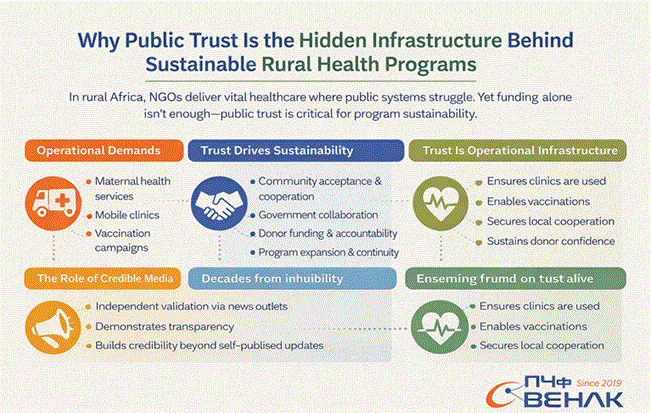
In many parts of Africa, access to basic healthcare still depends heavily on non-governmental organizations. Rural and hard-to-reach communities often rely on NGOs for maternal health services, vaccination campaigns, disease prevention, mobile clinics, and health education. While these programs are operationally demanding, their sustainability depends on more than medical expertise and funding. It depends on public trust.
In rural health delivery, trust is not an abstract concept. It determines whether communities accept services, whether governments cooperate, whether donors renew funding, and whether programs can scale beyond pilot phases. In this context, strategic communication and credible media presence play a critical but often underestimated role.
Across Africa, non-governmental organizations (NGOs) play a critical role in delivering essential services, supporting vulnerable communities, and implementing development programs in areas where state capacity is limited or absent. From rural healthcare and education to humanitarian response, climate adaptation, and livelihood support, NGOs often operate at the frontline—reaching populations that governments, markets, and formal institutions struggle to serve consistently. Their ability to operate effectively depends not only on technical capacity, but also on trust, credibility, funding continuity, and public accountability.
Rural Health Delivery and the Trust Gap
Rural healthcare programs operate in environments where misinformation, cultural barriers, and logistical challenges intersect. Communities may be unfamiliar with medical interventions, skeptical of external actors, or influenced by rumors that undermine health campaigns. NGOs must therefore earn trust continuously—not only through service delivery, but through communication.
Public trust also extends beyond beneficiaries. Ministries of health, regional authorities, donors, and implementing partners all evaluate whether an NGO is operating responsibly, transparently, and effectively. In this multi-stakeholder environment, visibility and credibility reinforce one another.
A Rural Health Context in Ethiopia
In Ethiopia, rural health outcomes have improved significantly over the past two decades, yet large gaps remain. Vast geography, dispersed populations, and limited infrastructure mean that NGOs continue to play a central role in maternal health, child nutrition, vaccination outreach, and community-based health education.
Many NGOs operate mobile clinics or support health extension programs in regions where government facilities are understaffed or difficult to access. These organizations often work in partnership with local health authorities, international donors, and community leaders.
In such settings, credibility determines continuity. An NGO that is trusted is more likely to receive community cooperation, government endorsement, and donor renewal. One that is misunderstood or invisible may struggle to sustain operations, regardless of technical competence.
Why Media Presence Matters for Health NGOs
Healthcare NGOs often assume that impact reports and donor submissions are sufficient to demonstrate value. While these documents are essential, they are typically read only by a limited audience. Media presence, by contrast, creates broader public understanding and third-party validation.
Credible media coverage—such as features on maternal health programs, interviews with medical professionals, or reporting on community health outcomes—signals that an NGO’s work has been independently observed and contextualized. This matters because health interventions are sensitive and can attract scrutiny.
For donors and authorities, media references help answer critical questions:
• Is this organization active and engaged?
• Is its work recognized beyond internal reporting?
• Does it operate transparently in complex environments?
• Is it accountable to the public as well as funders?
A single responsible media feature can often carry more reputational weight than multiple self-published updates.
Self-Published Information Versus Independent Validation
Most NGOs maintain websites, publish annual reports, and share updates through social media. These channels remain important for transparency and engagement. However, they are increasingly viewed as self-reported sources.
Independent media coverage differs in one key respect: it reflects editorial judgment. Journalists and editors decide whether a story is relevant, credible, and worth publishing. For external stakeholders, this distinction matters.
In rural health contexts, where misinformation can spread quickly, independent media plays a stabilizing role. It helps anchor narratives in verified information and professional reporting rather than rumor or speculation.
Trust as a Funding Enabler
Funding for rural health programs is often multi-year and performance-based. Donors assess not only outcomes, but reputational risk. Organizations that face controversy, misinformation, or unclear public narratives may find funding delayed or reduced, even if program delivery remains strong.
NGOs with a consistent, credible public record are easier to support. Their work is easier to justify internally to boards and oversight bodies. Their leadership appears accountable and professional.
Strategic communication therefore becomes part of funding sustainability, not an optional add-on.
Communicating Health Challenges Responsibly
Rural health programs rarely proceed without challenges. Supply disruptions, staff shortages, cultural resistance, and external shocks such as conflict or climate events can affect outcomes. Communicating these realities responsibly builds trust rather than undermines it.
Media engagement allows NGOs to explain constraints, highlight adaptive strategies, and demonstrate learning. This transparency reassures donors and partners that challenges are being managed professionally.
Silence, by contrast, can create suspicion. When no public information exists, stakeholders may assume problems are being hidden rather than addressed.
Digital Voices and Community Confidence
In addition to traditional media, digital platforms increasingly shape perceptions of health interventions. Health professionals, development practitioners, and community advocates often discuss public health issues on professional networks and social platforms.
When credible voices engage constructively with an NGO’s work—sharing insights, acknowledging impact, or contextualizing challenges—it reinforces legitimacy. This is not promotional activity. It is professional discourse that strengthens confidence among peers and funders. For health NGOs, careful engagement with such voices complements earned media without compromising neutrality.
Public Trust as Operational Infrastructure
Trust enables access. In rural health contexts, community acceptance determines whether clinics are used, vaccinations are accepted, and health education is effective. Public trust also facilitates cooperation with local authorities and reduces friction during implementation.
Media credibility contributes to this trust by ensuring that accurate information about programs is available publicly. It creates a reference point for stakeholders who may not interact directly with the NGO but influence its operating environment.
Conclusion: Health Impact Requires Public Confidence
Rural health NGOs operate at the intersection of service delivery, public perception, and accountability. Their ability to sustain programs depends not only on medical expertise, but on trust built over time.
Strategic communication and credible media presence help NGOs demonstrate transparency, reinforce legitimacy, and secure the confidence required to operate in complex rural environments.
For health NGOs working in countries like Ethiopia, public trust is not a by-product of success. It is a foundation for it.