
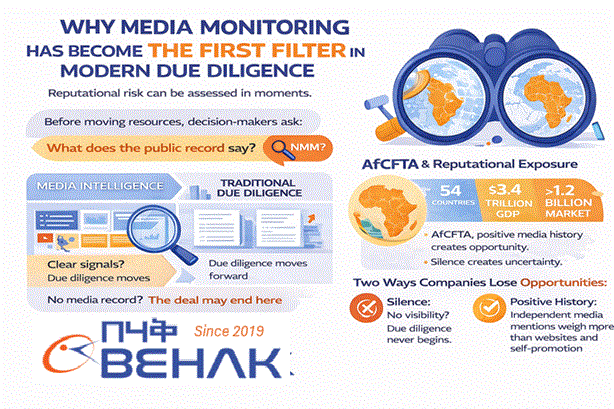
Due diligence is often associated with formal reviews—financial statements, legal documents, and compliance checks. While these steps remain essential, they are rarely the starting point. In modern cross-border business, due diligence usually begins with something far simpler: media monitoring.
Before investing time or resources, decision-makers want to understand reputational risk. Media searches provide the fastest way to do so.
The African Continental Free Trade Area (AfCFTA) was established through an agreement signed in 2018 and officially commenced trading in January 2021. It brings together 54 African countries, making it the largest free trade area in the world by number of participating states.
AfCFTA aims to create a single continental market for goods and services, facilitate the free movement of business persons and investments, and strengthen Africa’s position in global trade by promoting intra-African commerce, industrialization, and regional value chains.
As AfCFTA increases cross-border engagement, reputational exposure has become a shared concern. Companies are now evaluated through regional and international lenses, where media history plays a central role in early risk assessment.
Media Monitoring as an Early Risk Screen
Media monitoring allows potential partners and investors to identify red flags quickly. They look for patterns: unresolved controversies, inconsistent messaging, regulatory disputes, or reputational volatility. They also look for positive signals—evidence of stability, leadership credibility, and sustained activity.
This screening often determines whether formal due diligence proceeds at all.
An AfCFTA-Era Example
Consider an institutional investor based in Egypt exploring logistics and infrastructure partnerships with a mid-sized transport company in Tanzania. Before commissioning consultants or requesting detailed documentation, the investor conducts a reputational scan.
Analysts review media mentions involving the Tanzanian company, its leadership, and its operational history. A consistent record of neutral or positive business coverage reassures them that the company has operated publicly and responsibly. An absence of coverage, or unresolved negative stories, raises concerns that may halt engagement before it begins.
This is not an exception. It reflects standard practice.
Many African SMEs assume that visibility is cumulative—that appearing on multiple business directories, maintaining a company website, or having an active social media presence creates credibility. In practice, these forms of visibility carry limited weight in reputational assessment.
A single press release, interview, or feature published by a credible, independent media outlet often has far greater impact than ten directory listings or a well-designed website. This is because media coverage represents third-party validation. It signals that the business has been assessed, referenced, and deemed relevant by an external actor rather than simply promoting itself.
Why Silence Creates Risk in Due Diligence
A lack of media presence is not automatically negative, but it creates uncertainty. When no independent references exist, reviewers are forced to rely solely on self-reported information.
In AfCFTA markets, where alternatives are plentiful, uncertainty is costly. Decision-makers rarely invest time to resolve it when easier options exist.
As a result, companies with no visible media record often lose opportunities without ever being informed.
Positive Media History as a Confidence Signal
Companies with established media histories benefit from reputational cushioning. Past coverage suggests continuity, accountability, and experience with public scrutiny.
This does not eliminate risk, but it reduces perceived exposure. It allows decision-makers to proceed with greater confidence and fewer internal objections.
Media Monitoring Beyond Crisis Response
Many organizations associate media monitoring with crisis management. In reality, it is equally important for opportunity management.
Positive visibility accumulates over time. When opportunities arise, companies with established records appear prepared. Those without appear reactive or untested.
AfCFTA and Accelerated Decision-Making
AfCFTA compresses timelines. Cross-border opportunities emerge more frequently, and decisions must be made faster.
Media monitoring becomes a shortcut for prioritization. Companies with clear, positive public records move forward. Others are filtered out early.
Reputation Is Revealed, Not Created, During Due Diligence
Reputation is not built during due diligence. It is revealed during due diligence. Organizations that invest in visibility and media engagement as long-term processes enter AfCFTA markets with a measurable advantage. They are easier to assess, easier to trust, and easier to approve.