
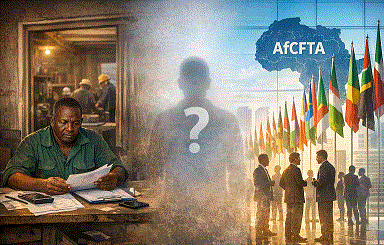
Many African small and medium enterprises (SMEs) believe that staying quiet publicly is a sign of seriousness. They focus on operations, production, and internal growth, assuming that visibility will naturally follow once results are achieved. In local markets, this approach may have worked in the past. Under AfCFTA, however, silence has become a strategic risk.
The African Continental Free Trade Area (AfCFTA) was established through an agreement signed in 2018 and officially commenced trading in January 2021. It brings together 54 African countries, making it the largest free trade area in the world by number of participating states. AfCFTA aims to create a single continental market for goods and services, facilitate the free movement of business persons and investments, and strengthen Africa’s position in global trade by promoting intra-African commerce, industrialization, and regional value chains.
As AfCFTA expands the pool of potential partners and competitors, African SMEs are no longer evaluated only by those who know them personally. They are assessed by decision-makers with limited context and little time. In this environment, silence does not signal professionalism. It signals uncertainty.
Silence Creates an Information Vacuum
When a company does not appear in public business conversations, that absence creates an information vacuum. Potential partners and investors are left to fill the gap themselves, often with caution. They may assume the company lacks scale, experience, or readiness for cross-border engagement—even when none of this is true. Silence forces outsiders to guess. In competitive markets, guessing is avoided.
A Southern Africa Illustration
Consider a mid-sized agribusiness company based in Botswana, specializing in beef processing and regional supply. Seeking expansion under AfCFTA, the company explores partnerships with agricultural buyers and logistics operators in Zambia, a key agricultural corridor country.
Before engaging formally, Zambian partners conduct informal background checks. They search for independent references, media mentions, or industry discussions involving the Botswana company. If they find no public information beyond the company’s website, uncertainty arises. The absence of visibility raises questions about scale, compliance, and operational reach—even though Botswana’s beef industry is well-regulated and reputable.
Had the company maintained a modest but consistent presence in regional business media, those questions would have been answered silently.
Why Silence Is Interpreted as Risk
In cross-border business, decision-makers are risk-averse by necessity. Silence increases perceived risk because it removes external validation. Without public signals, partners cannot easily assess whether a company has operated under scrutiny or engaged beyond its domestic market.
This does not mean that vocal companies are always better. It means that visible companies are easier to evaluate.
Visibility Is Not Noise
Many SMEs equate visibility with aggressive promotion. This misunderstanding leads them to avoid public engagement altogether. Strategic visibility, however, is not about constant messaging. It is about controlled, credible presence.
Thoughtful interviews, business features, or participation in sector discussions signal maturity rather than marketing. They demonstrate that a company understands its industry and is willing to be part of broader conversations.
AfCFTA Raises the Cost of Invisibility
Under AfCFTA, silence carries a higher cost than before. As borders open, buyers and partners compare options across multiple countries. They do not have time to investigate companies that provide no public context.
When faced with choice, decision-makers gravitate toward businesses that appear transparent and accountable.
Visibility as Reputation Insurance
Visibility also acts as reputation insurance. When questions arise, a visible company has a public record that speaks on its behalf. An invisible company must start from zero, explaining itself under pressure.
This difference affects not only partnerships but timelines. Deals involving visible companies move faster. Others stall.
From Silence to Strategic Presence
Breaking silence does not require large budgets or constant exposure. It requires intention. SMEs must decide where their voice matters and engage consistently in those spaces.
For African SMEs under AfCFTA, silence is no longer neutral. It is a strategic disadvantage that quietly limits growth.