
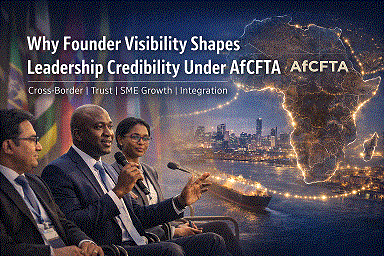
As African companies expand beyond domestic markets, leadership becomes part of the commercial equation. Under the African Continental Free Trade Area (AfCFTA), businesses are no longer assessed only within familiar local ecosystems.
They are evaluated by regional partners, institutional investors, financial institutions, and regulators who may have no prior exposure to the company or its leadership. In this environment, founder visibility is not a cosmetic consideration. It is a strategic asset.
AfCFTA has created a single continental framework designed to facilitate cross-border trade, industrial integration, and intra-African investment. As markets integrate, scrutiny naturally intensifies. When a company enters a new regional discussion—whether in manufacturing, fintech, agriculture, energy, or services—its leadership becomes the reference point through which external stakeholders interpret credibility.
Before contracts are drafted or site visits arranged, partners often conduct their own quiet evaluation. They search for the founder’s public presence. They review interviews, conference participation, policy commentary, or business media coverage. What they find influences how quickly trust forms.
In many African small and medium enterprises, the founder remains the primary strategist, negotiator, and public representative. Because of this concentration of authority, external stakeholders frequently treat leadership credibility as a proxy for institutional reliability.
A visible founder who has engaged thoughtfully in sector discussions signals preparedness for cross-border engagement. Such visibility suggests familiarity with regulatory expectations, governance standards, and regional market realities. It demonstrates that leadership can articulate strategy beyond a local context.
Silence, on the other hand, is interpreted carefully. Many entrepreneurs prefer to remain operationally focused, believing that performance alone will speak for itself. While operational excellence is indispensable, under AfCFTA expansion silence can introduce uncertainty.
Partners may question whether leadership is comfortable operating under broader scrutiny, whether it understands regional compliance expectations, or whether it can represent the organization in multilateral forums. The concern is rarely about integrity; it is about readiness.
Founder visibility does not require aggressive self-promotion. In fact, excessive personal branding can undermine institutional seriousness. Effective visibility is measured, sector-focused, and credibility-driven. When founders participate in industry panels, contribute expert commentary to reputable media, or engage in discussions about trade reform, supply chain resilience, or regulatory modernization, they position themselves—and their companies—as part of the continental conversation. The objective is not personal recognition. It is institutional signaling.
This becomes particularly important during due diligence. Investors and cross-border partners increasingly review not only financial records but also leadership background, public statements, governance posture, and professional affiliations. A consistent, professional public footprint reduces ambiguity. It shortens evaluation cycles and strengthens negotiation leverage. Leadership that has been visible over time is easier to assess, and therefore easier to trust.
AfCFTA is steadily raising expectations for what continental-ready leadership looks like. Businesses seeking to operate across linguistic, regulatory, and cultural boundaries must demonstrate more than production capacity. They must show that their leadership understands the complexities of integration, compliance, and cross-border reputation management. Founder visibility becomes preparation for that responsibility.
Credibility cannot be assembled at the moment opportunity appears. It is built gradually, through sustained and thoughtful engagement. For African SMEs positioning themselves for regional growth, founder visibility is not about spotlight—it is about strategic readiness. In a continent-wide marketplace, leadership presence becomes part of corporate infrastructure.