
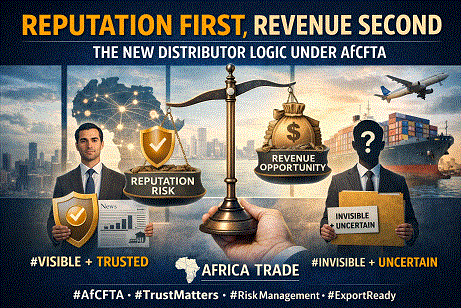
Across Africa’s integrated trade landscape, one quiet shift is reshaping who wins distribution partnerships and who never receives a callback. It is not pricing. It is not capacity. It is not even geography. It is visibility.
Since the operationalization of the African Continental Free Trade Area, suppliers have gained theoretical access to a continental market of more than one billion people. Yet access on paper does not translate into shelf space, representation, or distribution agreements. Between opportunity and execution stands a gatekeeper: the distributor. And distributors do not operate on optimism. They operate on risk.
The New First Step: Public Screening
Before a distributor replies to an email or agrees to a meeting, an internal screening process quietly begins. Executives search the supplier’s name. They review online presence. They examine media mentions. They assess whether the company has been referenced in credible business publications, industry forums, or regulatory announcements.
This is not full due diligence. It is a reputational filter.
In an AfCFTA environment defined by cross-border complexity, distributors cannot deeply audit every potential partner. Instead, they rely on visible signals of institutional maturity. Media visibility functions as an early indicator of seriousness, governance awareness, and export readiness.
Companies without a public footprint create friction before conversations even begin.
Distribution Is Reputation at Scale
When distributors agree to represent a supplier, they extend their own credibility to that relationship. If the supplier fails to comply with regulations, faces controversy, or disrupts supply chains, the distributor absorbs reputational damage alongside financial loss.
Under AfCFTA, where cross-border exposure increases operational and regulatory complexity, distributors are even more cautious. A supplier operating in one jurisdiction may face entirely different standards in another. Media visibility provides reassurance that the company has navigated external scrutiny before.
In this sense, public presence is not vanity. It is risk insurance.
Why Invisibility Signals Risk
Many African SMEs believe that operational strength is sufficient. They assume that once distributors evaluate product quality and pricing, the rest will follow.
In reality, many suppliers never reach that stage.
A company with no media references, no published leadership commentary, and no documented participation in industry dialogue appears opaque. Opacity forces distributors to ask harder internal questions: Why is there no trace? Has the company operated at scale before? Has it engaged with regulators or industry associations? Is it prepared for cross-border compliance?
When alternatives exist, distributors often choose the company that requires fewer explanations.
Under AfCFTA, invisibility increasingly translates into ineligibility.
Media as a Strategic Commercial Asset
For suppliers seeking regional expansion, media engagement must be reframed. It is not simply marketing. It is structured credibility-building.
Appearing in respected business publications, participating in industry discussions, and communicating milestones publicly demonstrate operational transparency. These actions signal that a company understands accountability beyond its domestic market.
Strategic communication builds familiarity. Familiarity reduces perceived risk. Reduced risk accelerates commercial conversations.
Distributors do not select suppliers because they are famous. They select suppliers because they appear institutionally stable.
Internal Decision Dynamics
Within distribution firms, supplier selection often requires executive or board approval. Decision-makers must justify why one supplier is chosen over another. When managers can reference independent coverage, public interviews, or documented achievements, their recommendations appear grounded.
The presence of third-party validation simplifies internal approval processes. It provides language for risk assessments and strengthens confidence in cross-border commitments.
In contrast, recommending a supplier with no visible footprint demands greater explanation and greater courage. In competitive markets, hesitation favors the visible.
AfCFTA Has Raised the Visibility Standard
AfCFTA has intensified supplier competition across Africa. Distributors now compare manufacturers across regions quickly and efficiently. In such an environment, credibility becomes a differentiator.
Price can be matched. Production capacity can be expanded. Logistics can be negotiated.
Reputational positioning, however, requires deliberate strategy.
Suppliers that invest in credible public engagement signal long-term intent. They demonstrate that they understand continental expansion requires more than product readiness—it requires perception readiness.
Building Eligibility Before Engagement
For African SMEs targeting distribution partnerships, preparation must begin before outreach. Companies should ensure that when a distributor searches their name, they find evidence of:
- Operational milestones
- Leadership insight
- Industry participation
- Regulatory awareness
- Growth narrative
These elements collectively form a public credibility architecture.
At BEHAK PR Solutions, we view media not as exposure, but as infrastructure. In AfCFTA markets, visibility determines whether a company enters the evaluation stage at all.
In a continent increasingly defined by integration and competition, the equation is straightforward:
- If you cannot be verified, you cannot be trusted.
- If you cannot be trusted, you will not be selected.
- Invisible means ineligible.