
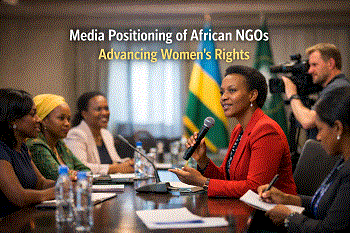
Programs that advance women’s rights and gender equality often operate in environments shaped by deeply rooted social norms, legal sensitivities, and political considerations.
For NGOs working in this space, progress depends not only on effective programming, but on sustained public trust and institutional legitimacy. In such contexts, strong and responsible media positioning becomes a strategic necessity.
Women’s rights initiatives frequently intersect with education, health, economic inclusion, governance, and social protection. These intersections expose NGOs to scrutiny from multiple stakeholders—governments, donors, community leaders, faith groups, and the public. Clear, credible communication helps ensure that programs are understood as constructive, evidence-based, and aligned with broader development goals.
Across Africa, non-governmental organizations (NGOs) play a critical role in delivering essential services, supporting vulnerable communities, and implementing development programs in areas where state capacity is limited or absent. From rural healthcare and education to humanitarian response, climate adaptation, and livelihood support, NGOs often operate at the frontline—reaching populations that governments, markets, and formal institutions struggle to serve consistently. Their ability to operate effectively depends not only on technical capacity, but also on trust, credibility, funding continuity, and public accountability.
Gender Programs Operate Under Heightened Sensitivity
Gender-focused NGOs often work on issues that challenge entrenched practices—such as access to education for girls, women’s economic participation, gender-based violence prevention, and legal rights. These interventions can be misunderstood or misrepresented if not communicated carefully.
In this environment, media positioning is not about advocacy alone. It is about framing work accurately, grounding narratives in evidence, and ensuring that programs are seen as inclusive and development-oriented rather than ideological.
Credible media engagement helps NGOs navigate these sensitivities by providing balanced context and reducing the risk of misinterpretation.
A Gender Equality Context in Rwanda
In Rwanda, gender equality has been integrated into national development strategies, with notable progress in women’s political participation, education, and economic inclusion. NGOs play a complementary role by supporting women’s entrepreneurship, access to finance, community leadership, and protection services.
These organizations often operate in partnership with government institutions and international donors, aligning programs with national priorities while addressing persistent gaps at the community level.
In such a context, credibility is essential. NGOs advancing women’s rights must demonstrate alignment with development objectives, cultural sensitivity, and accountability. Media visibility—handled responsibly—supports this by clarifying purpose and impact to a broad audience.
Why Media Positioning Shapes Legitimacy
For gender-focused NGOs, legitimacy is constantly assessed. Donors want assurance that programs are effective and respectful of local contexts. Governments want reassurance that initiatives support national development goals. Communities want clarity about benefits and intentions.
Media positioning helps address these concerns by making programs visible beyond internal reports. When credible media document women’s economic empowerment initiatives or community-based gender programs, they provide third-party validation that reassures stakeholders.
This validation is especially important for long-term funding, where donors assess not only outcomes but institutional reputation.
Moving Beyond Self-Published Narratives
NGOs working on women’s rights often produce detailed reports, toolkits, and policy briefs. While these materials are valuable, they typically circulate within limited professional circles.
Independent media coverage translates technical work into accessible narratives that reach wider audiences. It signals that programs have been evaluated externally and deemed relevant beyond the organization’s own communications.
For donors and partners, this external reference reduces uncertainty and reinforces confidence.
Communicating Progress and Resistance Responsibly
Gender equality programs rarely progress without resistance. Cultural norms, misinformation, and political sensitivities can create setbacks. Communicating these challenges transparently is part of responsible practice.
Media engagement allows NGOs to explain resistance constructively, highlight community dialogue, and demonstrate adaptive strategies. This honesty builds trust and shows donors that challenges are being managed thoughtfully rather than avoided.
Avoiding communication altogether can allow misconceptions to take root, undermining both programs and partnerships.
The Role of Influential Voices in Gender Discourse
Public discourse on gender issues is often shaped by respected academics, development practitioners, journalists, and community leaders who engage through professional platforms. These voices influence how gender programs are perceived by donors and policymakers.
When such figures reference NGO initiatives positively—by discussing evidence, lessons learned, or impact—they reinforce legitimacy. This is not promotional endorsement. It is professional acknowledgment within a broader development conversation.
When aligned carefully with earned media, these engagements strengthen reputational resilience.
Reputation as a Funding Stabilizer
Funding for women’s rights programs often spans multiple years and depends on donor confidence. Reputational concerns—whether grounded or speculative—can jeopardize continuity.
NGOs with clear, consistent public records are easier to support. Their work is easier to explain internally. Their leadership appears accountable and credible.
Strategic media positioning therefore contributes directly to funding stability.
Gender Programs and Institutional Maturity
As NGOs scale gender-focused programs, their reputation extends beyond individual projects. It becomes institutional. Media presence helps document this evolution, creating a public record of learning, adaptation, and impact.
This institutional credibility supports partnerships with governments, multilaterals, and regional initiatives.
Conclusion: Visibility Supports Inclusion
NGOs advancing women’s rights operate in complex social environments where trust, sensitivity, and legitimacy matter deeply. Strong media positioning—grounded in accuracy and respect—helps ensure that programs are understood, supported, and sustained.
In countries like Rwanda, where gender equality is both a national priority and an ongoing challenge, visibility is not about attention. It is about reinforcing inclusion through credibility.