
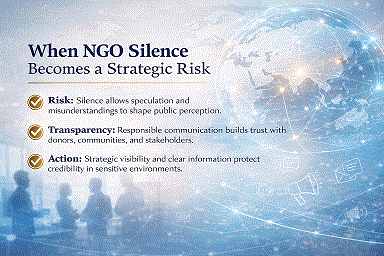
Across Africa’s development landscape, many non-governmental organizations operate under a longstanding assumption: that maintaining a low public profile helps protect neutrality and reduce exposure to controversy. In certain contexts this instinct is understandable. Development programs often operate in sensitive environments where public visibility must be managed carefully.
For NGOs working across humanitarian assistance, governance, health, education, and climate programs, public narratives increasingly shape how organizations are perceived by donors, governments, communities, and partners. When organizations remain silent in public discourse, they often leave a vacuum where speculation and misunderstanding can emerge.
Silence does not prevent narratives from forming. It simply means that narratives develop without the organization’s perspective.
Across digital platforms and traditional media, conversations about development programs unfold continuously. Analysts, journalists, policy commentators, and community voices interpret events and initiatives through their own lenses. When NGOs do not communicate proactively about their work, others may define the context in which that work is understood.
This dynamic has become particularly significant in environments where development programs intersect with political or social sensitivities. Governance initiatives, gender equality programs, humanitarian operations, and refugee assistance frequently attract scrutiny from diverse stakeholders.
In these settings, the absence of publicly accessible information about an organization’s mission, governance, and track record can raise questions even when programs are functioning effectively.
International accountability frameworks emphasize the importance of transparency and communication in development work. The Core Humanitarian Standard highlights that communities and stakeholders should have access to clear, accurate information about humanitarian and development programs in order to strengthen accountability and trust.
Donors increasingly conduct reputational reviews before committing funds. These reviews often include searches for credible public references about the organizations they support. NGOs with little visible public information may face additional scrutiny simply because stakeholders cannot easily verify their activities. Silence can therefore slow decision-making processes that depend on institutional confidence.
Community trust can also be affected. In areas where NGOs provide services such as healthcare, water access, education support, or disaster relief, communities often rely on public information to understand who is delivering assistance and why.
When credible information about programs is unavailable, rumors or incomplete explanations may circulate. These misunderstandings can create unnecessary tension or skepticism toward initiatives designed to benefit local populations.
Development policy institutions also increasingly emphasize transparency as a core pillar of trust in public institutions and development cooperation. Research and guidance from the Organization for Economic Co-operation and Development (OECD) indicate that open communication and accessible information strengthen institutional credibility and help build confidence among stakeholders.
This does not mean NGOs must pursue aggressive publicity strategies. Responsible communication is different from promotional messaging. Strategic communication focuses on ensuring that accurate, contextualized information about an organization’s work exists within credible channels.
Independent media coverage plays a valuable role in this process. When journalists document development programs responsibly, they provide third-party validation that helps audiences understand the organization’s objectives and activities.
Professional discourse on digital platforms also contributes to narrative clarity. Development practitioners, researchers, and policy experts often discuss sector trends publicly. When NGOs contribute insights or share evidence from their work, they help anchor discussions in operational realities.
Another advantage of proactive communication is preparedness during moments of scrutiny. Organizations with established public narratives are better positioned to respond calmly when questions arise. Stakeholders already have context for interpreting events rather than encountering an institution that appears suddenly in the spotlight.
In contrast, NGOs that remain largely invisible in public discourse may struggle to respond effectively when unexpected controversies emerge. Without prior reference points, stakeholders may rely on incomplete or misleading information.
Strategic visibility therefore functions as a form of reputational infrastructure. It ensures that accurate information about an organization’s work is accessible before misunderstandings occur.
For NGOs operating in complex environments, communication should not be viewed as optional visibility. It is part of institutional transparency and accountability.
Responsible communication strengthens trust among communities, reassures donors and partners, and protects the credibility necessary for development work to continue.
Silence may once have been considered a safeguard for neutrality. In today’s interconnected information landscape, however, thoughtful communication is often the stronger protection.
Organizations seeking to strengthen their communication frameworks can explore structured approaches to credibility-based media engagement and narrative positioning
For institutions operating in sensitive development environments, professional guidance on responsible public positioning can help ensure that accurate narratives about their work remain visible and accessible