
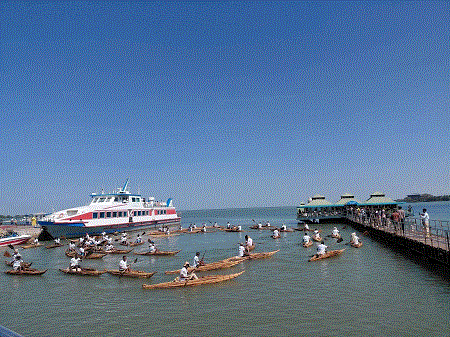
Ethiopia’s tourism appeal lies not in a single landmark but in a mosaic of regions, each with its own historical depth, ecological richness, and cultural traditions.
Traveling across the country means moving between dramatically different contexts—ancient civilizations, soaring highlands, volcanic landscapes, and vibrant urban centers—all contributing to Ethiopia’s national story.
Northern Historical Circuit: Heritage and Faith
The north is Ethiopia’s historical heartland, home to some of Africa’s most remarkable cultural treasures.
- Axum: Once a powerful center of trade, Axum’s towering stelae and archaeological remains reveal the sophistication of one of sub-Saharan Africa’s earliest civilizations.
- Lalibela: Famous for its rock-hewn churches carved into volcanic stone, Lalibela remains a living site of worship and pilgrimage, not just a preserved monument.
Both Axum and Lalibela are UNESCO World Heritage Sites, recognized globally yet deeply rooted in local religious life. Visitors here encounter Ethiopia’s past through the lens of enduring spiritual traditions.
Highland Ecosystems: Peaks and Biodiversity
The Ethiopian highlands offer a striking contrast, defined by altitude and ecological diversity.
Simien Mountains National Park: With dramatic escarpments and high plateaus, the park shelters unique species such as the Gelada monkey and Walia ibex. Its landscapes are as geologically impressive as they are biologically rich.
Exploring the highlands often means trekking through rugged terrain, where conservation and adventure go hand in hand.
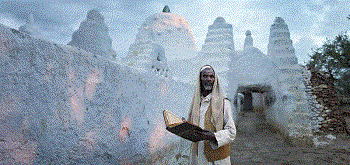
Rift Valley and Water Systems: Lakes and Livelihoods
The Rift Valley introduces a landscape shaped by lakes, volcanic activity, and human settlement.
- Lake Tana: Source of the Blue Nile, Lake Tana blends ecological importance with cultural heritage, housing island monasteries that safeguard centuries-old manuscripts.
- Rift Valley Lakes: Further south, lakes support fishing communities, agriculture, and growing eco-tourism ventures.
These regions highlight Ethiopia’s living connection between environment and local economies, aligning with global trends in sustainable tourism.
Extreme Environments: The Danakil Depression
Few places on Earth rival the Danakil Depression for geological drama. With active volcanoes, salt flats, and searing heat, it is often described as one of the planet’s harshest environments.
Travel here requires guided expeditions due to safety and logistics, making it a destination of controlled access. Beyond tourism, the region is a focus of scientific research into tectonic and geothermal processes.
Urban Gateway: Addis Ababa
Most journeys begin in Addis Ababa, Ethiopia’s capital and aviation hub.
The city blends modern infrastructure with cultural institutions, offering visitors a first glimpse of contemporary Ethiopia. While less historic than the northern circuit, Addis provides essential context—diplomatic, commercial, and cultural—for understanding the country today.
Structuring Travel Across Regions
Ethiopia’s diversity demands thoughtful planning. A typical itinerary might include:
- Historical centers (Axum, Lalibela)
- Highland adventures (Simien Mountains)
- Extreme landscapes (Danakil Depression)
- Urban transitions (Addis Ababa)
Domestic flights, road networks, and guided tours, often facilitated by Ethiopian Airlines, help travelers navigate the country’s varied terrains and climates.
Local Services and Visitor Support
- Tourism infrastructure in Ethiopia combines formal hospitality with local services.
- Urban centers: International hotels, restaurants, and transport providers.
- Regional destinations: Locally run guesthouses, guides, tour operators, and small businesses that connect visitors directly with community life.
These networks ensure access while reflecting Ethiopia’s grassroots approach to tourism development.
Conclusion
Ethiopia’s destinations are not interchangeable stops on a standard itinerary. Each region embodies a unique blend of history, ecology, and culture. To travel here is to engage with diverse systems of meaning—religious heritage, environmental wonder, and social continuity.
The country’s tourism strength lies in this variety, offering visitors not just attractions, but a deeper narrative of civilization, landscape, and identity.
EDITOR’S NOTE: This content is provided by BEHAK Multimedia PLC, a communications and public relations firm in Ethiopia and the publisher of New Business Ethiopia. BEHAK supports businesses in enhancing visibility, credibility, and reputation while strengthening branding efforts through well researched sponsored content. Such content may include hyperlinks to a client’s website or social media pages, offering direct access for global potential clients.
By incorporating carefully researched digital content with hyperlinks to company websites and social media pages, BEHAK enables businesses to promote their services to global potential clients.
Businesses interested in enhancing their digital visibility through such well researched sponsored content are invited to reach out directly to the BEHAK Team.